
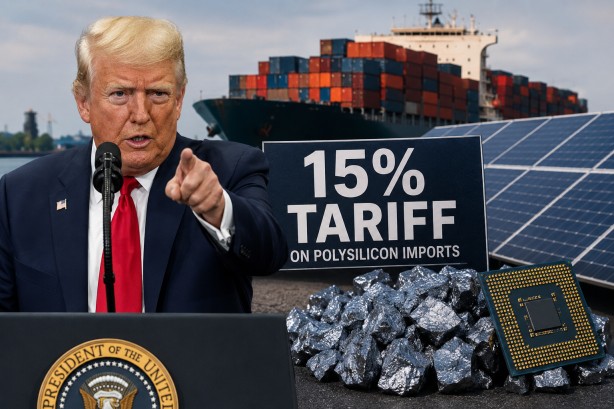
In a strategic move to bolster domestic industries, US President Donald Trump has announced a 15% tariff on imported products that incorporate polysilicon. This critical material is essential in the production of semiconductors and solar panels, and the new tariff will be effective from December 4. The administration has highlighted the aim of these tariffs as reducing dependency on Chinese imports and enhancing local manufacturing capabilities.
Polysilicon, a highly refined form of silicon, plays an integral role in the production of semiconductors that drive artificial intelligence systems and data centers, as well as in the manufacture of solar cells and panels. Currently, China holds the position as the leading global producer of polysilicon, making the US heavily reliant on imports from the region. To counter this dependency, the US has set new minimum import prices at $21 per kilogram for polysilicon, $100 per kilogram for polysilicon ingots and wafers, $0.22 per watt for solar cells, and $0.38 per watt for solar modules and panels.
The US government has justified these measures as necessary steps to ensure the viability of domestic polysilicon production, which is closely linked to the nation’s economic and national security interests. By reinforcing these critical supply chains, the administration seeks to support American manufacturing and technology sectors. In response, China has criticized the tariffs, claiming that the US is leveraging national security as a pretext for protectionist policies that could potentially disrupt trade relations between the two nations.
Within the United States, two primary facilities are engaged in polysilicon production: Hemlock Semiconductor located in Michigan and Wacker Chemie in Tennessee. The new policy framework not only imposes tariffs but also opens the door for government incentives aimed at encouraging investment in domestic polysilicon and related manufacturing operations.
This development occurs amidst China’s ongoing export growth, particularly in the realms of electronics, artificial intelligence products, and other high-value manufacturing sectors. The tariff is part of a broader US strategy to safeguard its technological industries while addressing trade imbalances and competitive pressures from China.