
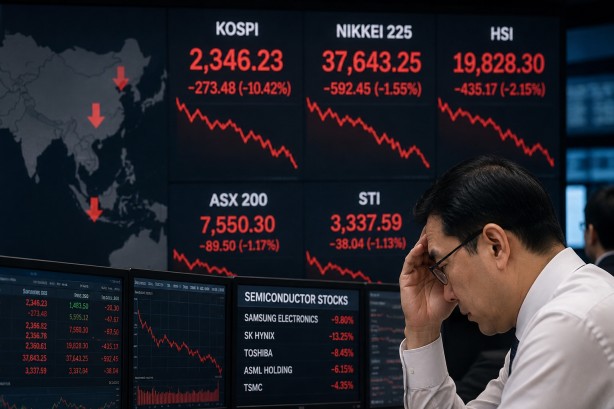
Tuesday saw declines across Asian stock markets, with South Korea experiencing a significant downturn. The Kospi index in South Korea plunged more than 10%, driven by substantial sell-offs in the semiconductor sector. Major companies like Samsung Electronics and SK Hynix saw their shares drop by approximately 12%. The sell-off was fueled by investor concerns over escalating competition from Chinese AI startups and chipmakers, which could potentially hinder the expansion of the global artificial intelligence market.
While the sell-off in South Korea was the most pronounced, other major Asian markets also closed in the red. Japan’s Nikkei, Taiwan’s Taiex, Hong Kong’s Hang Seng, and China’s Shanghai Composite all registered losses by the end of the trading day. The regional decline reflects broader market apprehensions about the future of the tech sector amidst increasing international competition.
However, not all markets followed the same downward trajectory. Australia’s S&P/ASX 200 stood out as the lone major index in the region to post gains, offering a slight contrast to the otherwise negative trend observed across Asia. This divergence highlights the varied responses of regional markets to the current economic pressures and geopolitical dynamics.
In parallel with the stock market fluctuations, oil prices saw a decrease, coinciding with a reduction in tensions between the United States and Iran. This easing of geopolitical strain has sparked optimism for renewed diplomatic discussions, which in turn has alleviated some concerns about global energy supply disruptions. The potential for diplomatic progress appears to be providing a stabilizing effect on the energy market, even as uncertainties persist in other sectors.